Renter-friendly lighting ideas to brighten a dark apartment
This post may contain affiliate links. If you buy through them we may earn a small commission at no extra cost to you. Read our disclosure.
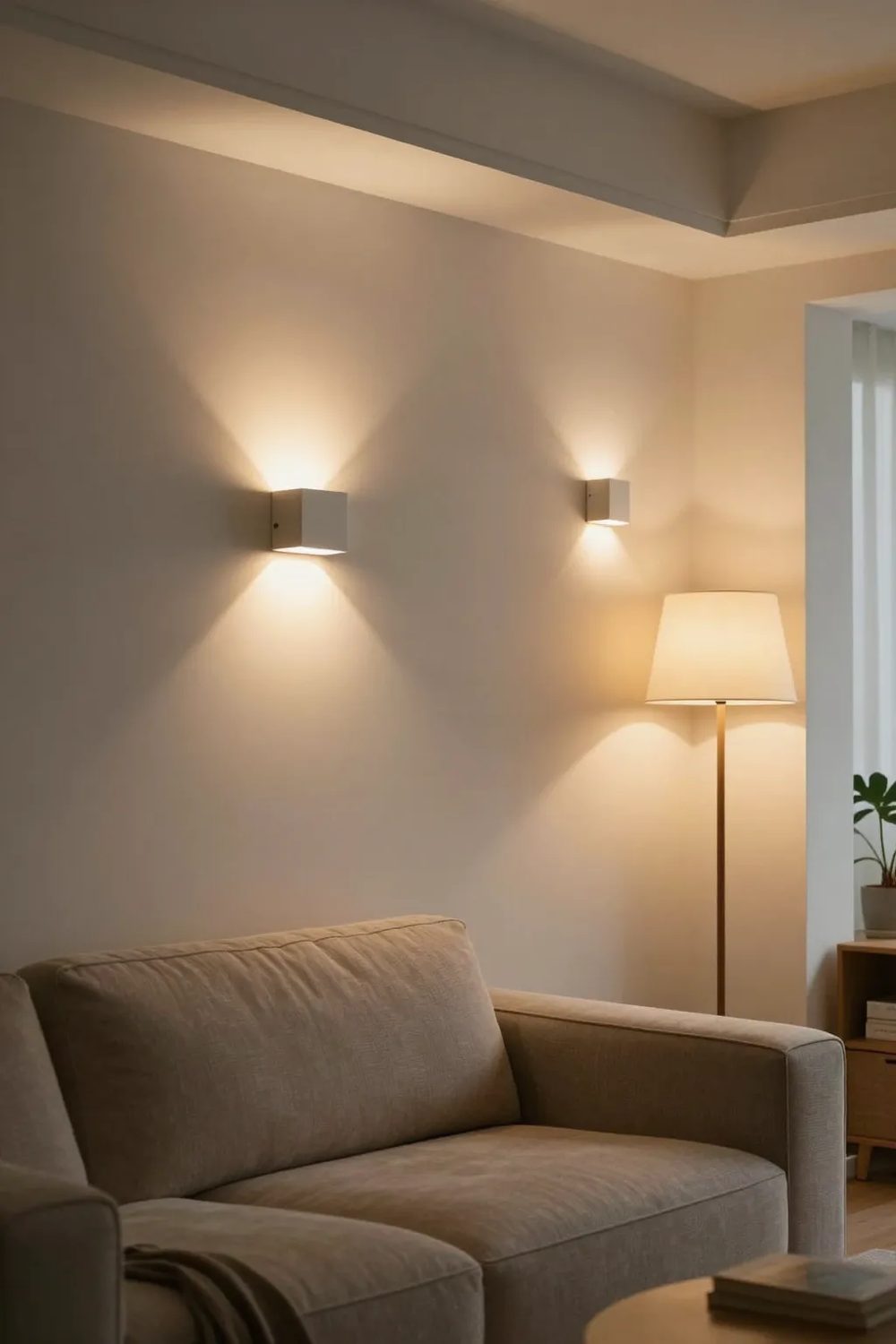
A lot of rentals come with one ceiling light per room, usually with one harsh bulb in it. Some living rooms don’t even get that, just a switched outlet and good luck. You can’t move the windows. You can change almost everything else about how the place is lit, and none of it needs an electrician.
Why one light isn’t enough
Lighting people talk about layers. General light that fills the room. Task light for reading or chopping or working. And softer accent light that makes a room feel nice at 9pm (table lamps, LED strips, candles).
A dark apartment usually has exactly one of those, the ceiling light. Adding the other two is where the big difference comes from.
How to read a bulb box
Ignore the watts. Two other numbers matter more.
Lumens are brightness. For reference, the U.S. Department of Energy notes that an old 60-watt incandescent put out about 800 lumens, and a typical LED “60-watt equivalent” gives about the same while using much less power. If a room feels dim, check the lumens on the bulbs you already have before buying new lamps. A brighter bulb in the same lamp might be the whole fix. (Stay under the fixture’s max rating.)
Color temperature is warmth, in Kelvin. 2700 to 3000K is warm white, close to old incandescents, and nice in living rooms and bedrooms. 3500 to 4100K is neutral, better for kitchens, bathrooms and desks. 5000K and up is bluish “daylight.” Fine for detailed work. Kind of a dentist’s office in a living room.
Try not to mix wildly different temperatures in one room. It looks off in a way people notice without knowing why.
There’s also CRI, which is how accurately a light shows color, on a scale up to 100. Bulbs at 90 or above make skin, food and fabric look normal. Worth it in the kitchen, bathroom, and wherever you do your makeup or shave.
Plug-in wall sconces
If I could only recommend one renter lighting thing, it’d be these. They look hardwired. They plug into an outlet.
Most mount with two small screws or a plate, and some lighter ones hang on heavy-duty picture-hanging strips (check the weight). Hide the cord with an adhesive cord cover painted the wall color, or lean into it with a nice fabric cord. Put them beside the bed (bye, crowded nightstand), on either side of a sofa, over a desk, by a mirror.
Battery or rechargeable sconces skip the cord entirely, often with a remote. They’re dimmer and you have to recharge them, which gets old. Still handy where there’s no outlet.
Floor lamps
They don’t take any surface space and they can light a whole corner.
Torchiere lamps point up at the ceiling, and the light bounces back down soft and even. If your living room has no overhead light, start with one of these. Arc lamps reach over a sofa. Tree lamps with several adjustable heads can do general and task light at once, though most of them are not exactly pretty.
Put the first lamp in the darkest corner. Lit corners make a room feel bigger.
Table lamps and shades
A pair of matching lamps on a console or either side of a sofa adds warmth. Little ones on shelves or a kitchen counter add glow.
Shades change everything. White or cream fabric spreads soft warm light. Dark or opaque shades push light up and down in pools, which is moodier but won’t brighten a room much.
Smart bulbs and smart plugs
Smart bulbs change brightness (and often color temperature) from an app or voice assistant. Smart plugs turn any lamp into one you can control remotely.
For renters this is great for a few reasons. You can schedule lamps to come on at dusk, so you never walk into a black apartment. You can group lamps so they act like a wall switch. You can go cool and bright in the morning and warm and dim at night. And all of it unscrews or unplugs when you move.
LED strips
Cheap and handy. Under kitchen cabinets for task light. Behind the TV or headboard for a soft backlight. Under the bed frame as a night light. Inside closets with a motion sensor. On top of tall furniture, pointing up, to bounce light off the ceiling.
The adhesive can pull paint, so test somewhere hidden or stick the strips to furniture instead of walls.
The ceiling fixture you’re stuck with
Even if it stays, swap the bulb for a brighter, higher-CRI LED in the right color temperature for the room. A smart bulb makes it dimmable without touching the switch.
If the fixture itself is hideous, ask your landlord. Many allow a replacement if a licensed electrician installs it and you put the original back when you leave.
Bounce what you’ve got
Mirrors next to or across from windows push daylight further in. A big floor mirror is the easiest. Pale textiles (rug, curtains, bedding) reflect more light than dark ones. Glossy and metallic things like a brass lamp or glass vase help a bit too.
And the windows. Sheer curtains for privacy without losing light. Hang curtains wide so they don’t cover the glass when open. Clear the sills. Clean the glass, honestly, because dirty windows block more light than you’d guess.
Room by room, quickly
Living room: torchiere or arc lamp, a reading lamp by the sofa, a table lamp on a shelf, maybe a strip behind the TV. Bedroom: sconces or lamps on both sides of the bed and a dim night light for 3am. Kitchen: bright high-CRI under-cabinet light plus the brightest suitable bulb overhead. Bathroom: bright neutral light at the mirror. Entryway: a small lamp or a motion-sensor light so you’re not fumbling for the switch.
Safety, briefly
Don’t go over the max bulb wattage marked on a fixture. Use properly rated extension cords and power strips, and don’t plug power strips into other power strips. Keep cords out of walkways and out from under rugs, where they can overheat. Outdoor products outside.
If you want somewhere to start this weekend, count the light sources in each room. Any room with only one is your priority. Then check the lumens on the bulbs you own, and go buy one floor lamp for the darkest corner.