Small entryway ideas for apartments with no foyer
This post may contain affiliate links. If you buy through them we may earn a small commission at no extra cost to you. Read our disclosure.
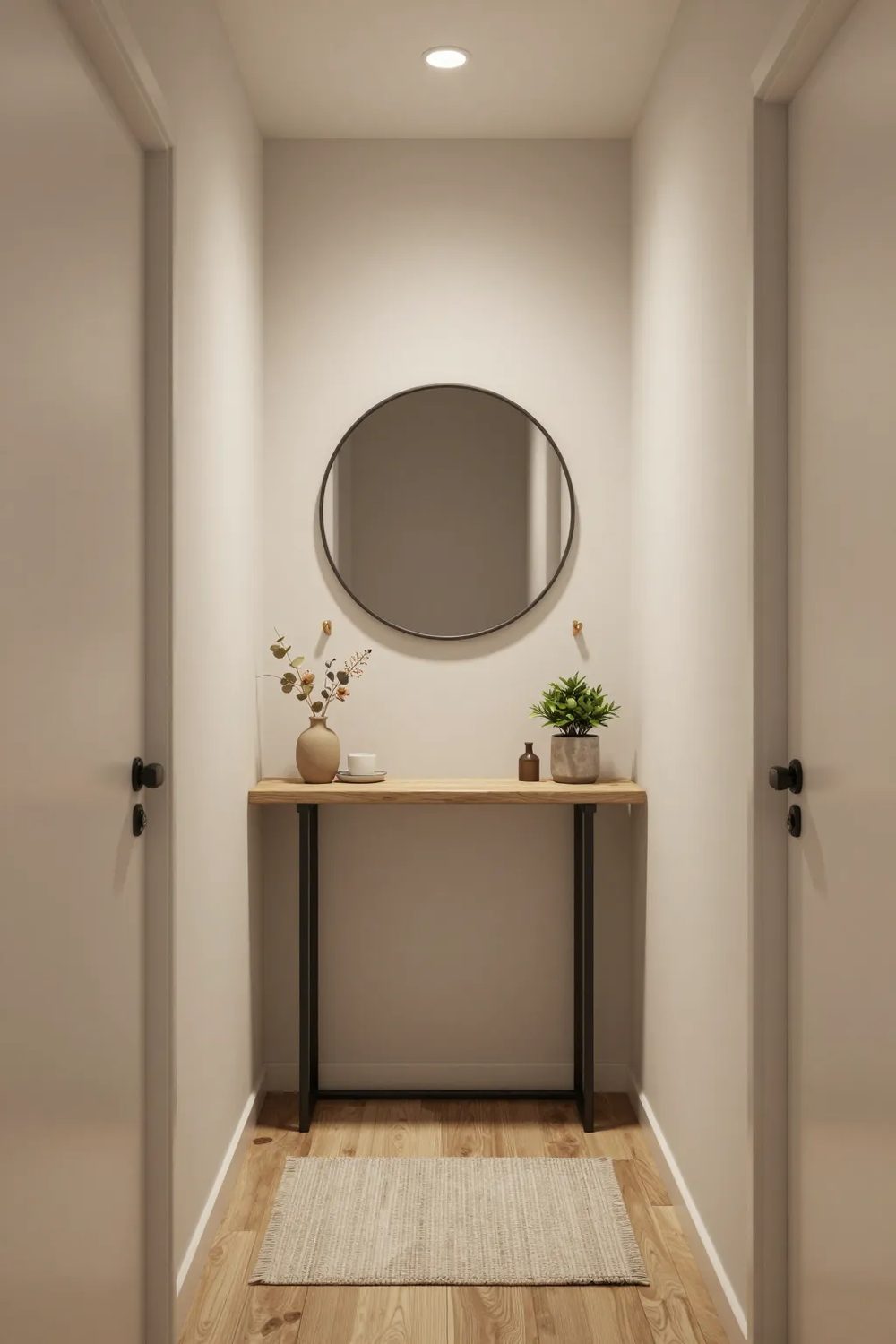
Lots of apartments open straight into the living room or kitchen. No foyer, no coat closet, nowhere to put your keys. So shoes pile up by the door, bags land on the sofa, and mail colonizes the kitchen counter.
You can make an entryway where there isn’t one. It just has a few jobs.
The jobs
Somewhere to drop keys, wallet, sunglasses and mail. Somewhere for shoes so they don’t wander into the rest of the apartment. Somewhere to hang a coat and a bag. A mirror for the last look on your way out. And light, so you’re not walking into a black room at night.
If your setup covers those, it works. Anything past that is style, and style is the fun part, but it’s second.
Make it read as an entryway
No walls needed. A rug or runner just inside the door is the simplest signal. Go durable and flat-weave or low-pile so it’s easy to clean and doesn’t catch the door, and put a pad under it so it doesn’t slide.
A change on the wall helps too, like a removable wallpaper panel or one big piece of art. A console or bench next to the door gives you a destination. A small bookcase, folding screen or tall plant between the door and the living area makes a little transition, so you don’t walk in and immediately see the couch.
(Honestly, skip the gallery wall by the door. In a narrow entry it’s a lot of frames to knock with a backpack. One big piece does the job.)
A surface for the stuff in your pockets
A slim console is the obvious move. Look for about 10 to 14 inches deep for tight spots, and some are made specifically for narrow halls. Other options are a floating shelf if you’re allowed a couple of holes, a small chest of drawers if you also need room for gloves and dog leashes, a wall-mounted mail organizer, or just the top of a shoe cabinet.
Then put a tray or bowl on it. That’s the part that matters. Without a container, the surface becomes a clutter magnet within a week. With one, the keys have a home.
Shoes (the real problem)
Slim shoe cabinets with tip-out drawers hold a surprising number of pairs in very little depth, and the top doubles as your console. Tall narrow ones should be anchored so they can’t tip. Ask your landlord about one small anchor screw.
A shoe bench gives you a seat to put shoes on with storage underneath. A tiered rack is cheap and fine. If it rains or snows where you live, add a boot tray to save the floor. Baskets under a console hide shoes if you’d rather not see them.
Only keep the shoes you wear a lot by the door. The rest can live in the bedroom closet. This one rule probably fixes half the mess.
Hooks
Without drilling, you’ve got freestanding coat racks, over-the-door hooks on the inside of the front door (make sure it still closes and locks properly), and adhesive hooks for light stuff like keys. Be realistic about adhesive, though. Coats and heavy bags are usually over the limit, and a hook that drops your bag at 2am is not fun.
With permission, a wall-mounted hook rail is the best version. Use anchors that suit your wall type and patch when you leave. A hall tree (bench, hooks and shelf in one) may need anchoring.
Mirror
A mirror by the door is useful and it bounces light around, so a cramped entry feels bigger. Lean a floor mirror (with an anti-tip strap if needed), hang one over the console with picture-hanging hardware or rated strips for light ones, or use an over-the-door mirror on a nearby closet. Round mirrors soften a space that’s all straight lines. A mirror with a little shelf is a drop zone too.
Light
Coming home to a dark apartment is grim. A small table lamp on the console works. So does a plug-in sconce if there’s an outlet nearby. Battery stick-on motion lights come on by themselves when you walk in, which is great. Or a smart bulb on a schedule.
The nice extras
A plant, and if there’s no window nearby, a ZZ plant or pothos copes with dim spots (keep toxic plants away from pets). A candle or diffuser, kept well away from coats and never left burning when you head out. A basket for reusable shopping bags, so you actually remember them.
Depending on your layout
Door opens right into the living room. Narrow console or shoe cabinet against the wall beside the door, runner, mirror above. Room to spare? Put a tall bookcase or screen perpendicular to the wall to make a partial divider from the sofa.
Door opens into a hallway. Use the hallway walls. Slim console, hooks, a runner along the length. Keep the floor clear.
Door is next to the kitchen. Claim a bit of wall or the end of the counter for keys and mail. A small cart or narrow cabinet for shoes and bags.
No wall at all. Use the back of the door. Over-the-door organizer for shoes, hooks for coats, and a tray on whatever surface is nearest.
Keeping it from falling apart
Entryways only stay tidy if it’s easy. Empty the mail tray every day or two and recycle the junk right there. Move off-season coats and shoes somewhere else. Everyone in the home gets a hook and a shoe spot. If you’ve got roommates, agree on one or two pairs of shoes each at the door, one hook per person, and a shared basket for packages. Labeling hooks with initials sounds fussy. It stops one person’s stuff slowly taking over.
On a tight budget, go in this order: a bowl for keys (almost free, immediately fewer lost-key mornings), a washable mat or runner inside the door, a basic shoe rack, over-the-door hooks, then a secondhand console or small dresser, and a secondhand mirror. Thrift stores and local marketplaces are full of both.